By Mackenzie Ciolino, Marketing Intern, Summer 2024
Sophie Wensman comes from a legacy of science and curiosity. She was introduced to science and the marine world at a young age through her mother, Michele Wensman, who volunteered, then worked here at Seacoast Science Center. Sophie’s education, the research she has performed across the world, and her experience with teaching are all a testament to her passion for science. I reached out to Sophie to learn more about her journey from a child participating in SSC’s programs to an accomplished person with an impressive amount of research experience under her belt.
Sophie credits her mother as a strong, positive influence on her as a young person. She homeschooled Sophie and her brother, “creating a curriculum that was rich with hands-on experiences,” Sophie says. The three of them became University of New Hampshire Cooperative Extension/Sea Grant Marine Docents when Sophie was eight, then became naturalists at Seacoast Science Center the year after. Sophie explains, “We had the incredible opportunity to teach school groups about the rocky shore. These experiences, guided by my mother’s passion and expertise, shaped my understanding of the natural world and sparked a lifelong interest in environmental science.”
Sophie furthered her interests in the natural sciences when assisting with SSC’s Big Fish Little Fish program for preschool-aged children and their favorite adults, and Treks, the early learner camp program. She describes the experiences as “incredibly rewarding and educational, from tide pool explorations to building fairy houses.” The people at the Center were also an inspiration for Sophie. “I had the privilege of working closely with Marilyn Gilmour, who was an incredible teacher and mentor. Her passion for environmental education and her dedication to the campers was truly inspiring,” she says. Also, for Sophie, “Watching the campers’ eyes light up as they discovered something new about the ocean was incredibly motivating.” The culture of education and community nurtured by SSC became a launch point for her career.
After high school, Sophie double-majored in chemistry and earth/space science at the University of Michigan. She worked as an intern for the Analytical Chemistry department and later conducted research with the Joint Institute for the Study of the Atmosphere and Ocean. Then, she earned a position aboard the NOAA ship R. V. Ronald H. Brown Climate and Ocean – variability, predictability, and change cruise. There, she assisted with chlorofluorocarbon sampling and analysis. Some particularly memorable moments for her included “watching whales and dolphins follow the ship, the most spectacular sunrises, and being stuck in fog so thick I couldn’t see past the railing of the ship for about 3 days.” Her experience on the Ron Brown inspired her to pursue remote fieldwork later in her career.
This pursuit has taken her to the far reaches of the world. She explains, “I have been very fortunate to travel across the US, to the Pacific Ocean, Greenland, and Europe as part of my education and research, and each location has offered a unique blend of challenges and rewards.” She cites working strange hours, missing loved ones, and being disconnected from the rest of the world as some of those challenges. However, her research also came with incredible experiences. Back on the Ron Brown, weird hours afforded her the chance “to see the most spectacular sunrises.” She also recalls, “One of my favorite moments from being in a remote field camp was walking out of our camp and finding day-old Arctic Fox prints in the middle of the ice sheet, 250 miles from the nearest coastline and easily accessible food. It was amazing to think about the resiliency of this animal in such a harsh environment.”
Sophie earned her Graduate Certificate in College and University Teaching at Oregon State University in 2020, and later her Ph.D. in Ocean, Earth, and Atmospheric Sciences. The topic of her dissertation was “Investigating Influences of Natural and Anthropogenic Lead Sources on Environmental and Temporal Scales: Evidence from Oysters and Ice Cores.” Sophie explains how “Working at SSC provided me with a strong understanding of marine ecosystems and the intricacies of coastal environments. This background was invaluable when I transitioned to studying oysters, as it helped me appreciate their ecological roles and the impacts of environmental changes on them.”
Another special interest of Sophie’s is heavy metals and geochemistry. She explains, “I was drawn to the field through research opportunities at the University of Michigan, where I was a lab tech for the Biogeochemistry and Environmental Isotope Geochemistry Laboratory. It was there that I first began to realize the power of environmental geochemistry for answering a diverse array of questions.” This interest brought her to Greenland in 2022, as a research fellow at Desert Research Institute in Reno, Nevada. There, she analyzed ice cores to examine changes in human activity over the last 2,500 years.
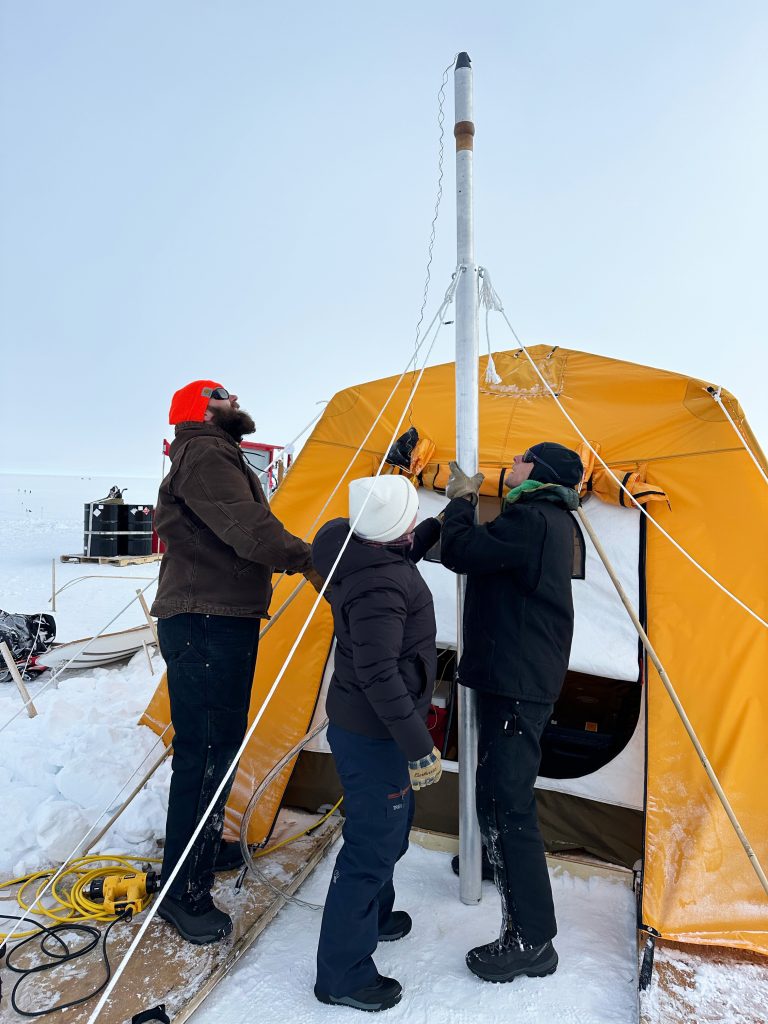
Sophie had actually just returned to the US from her second trip to Greenland when I contacted her in the summer of 2024! On this second trip, “We conducted our research out of Summit Station, the only high altitude, high latitude, inland, year-round observing station in the Arctic.” There, Sophie and her team “collected data about the surrounding ice, such as temperature changes and dust layers, that will be used in our research to date the ice and eventually find a continuous section of ice that dates back over a million years.” Currently, Sophie is working on several projects, including a National Science Foundation research grant “to trace sources of lead pollution and quantify emissions from those sources.” This will reveal insight into different time periods and how historical events impacted economic activities.
When asked if she has an important message she would like to share with children or families today, Sophie says: “Something I’ve carried with me that was instilled in me by my mom and my time at the SSC is the value of curiosity and exploring the natural world. Science and nature offer endless opportunities for learning and discovery. Encouraging curiosity helps us understand our environment, solve problems, and appreciate the beauty of the world around us. Whether it’s observing wildlife, experimenting with simple science projects, or learning about the history of our planet, every bit of exploration contributes to a deeper understanding of how everything is connected. Embrace your questions, seek out new experiences, and never stop exploring—there’s always something new to learn and discover!”